Tuesday, March 27, 2012

Day 5: March 26, 2012

In addition to performing surgery and physical therapy, a large facet of Operation Walk is education. It has been an amazing opportunity to learn about a different culture, healthcare system, in addition to getting to know an remarkable group of patients, medical students, and hospital staff. With that sense of professional open exchange, we have also used this opportunity impart our techniques and practices. In preparation for the mission, nursing coordinator Barbara Aggouras provided an educational inservice with the floor and ancillary nurses as an orientation. Likewise, OR Coordinator Paul Laemmle performed an orientation to the OR Staff. Our goal is to provide the same safe and professional care as we would at our home institutions. As such, we have incorporated use of the WHO surgical safety checklist since 2009 to ensure he correct site and patient prior to every surgery.

Each day of the trip has been an education. The severity of disease amongst our patients and the opportunity to work with such experienced and skillful surgeons is a tremendous opportunity for the orthopaedic residents. Each year three orthopaedic residents accompany the trip, including a PGY3, PGY4, PGY5. They serve to help manage the floor as well as work one on one with the attendings in the OR . The PGY 4 serves as the chief medical officer and was the primary coordinator with Dr. Alcantra and his team before and during the mission. Dr. Collin May performed the role this year. He did a superb job and the success of the mission thus far is truly a credit to his hard work. Unique to this experience, we are able to be involved in the care of the patient from start to finish, which is a luxury we are not always afforded in residency. From the first day during the preoperative evaluations and ground rounds, where we reviewed each patient and their imaging and discussed of the indications and special considerations for each case, to XRay rounds this morning where we reviewed each patient's post-operative radiographs and the intra-operative findings while the surgeon's discussed why and how they performed each procedure. Having the opportunity to work and learn from 4 leaders in the field has been an amazing opportunity.

The spectrum of disease seen here is vast, providing an education in of itself and a chance to learn how to manage problems we might not otherwise encounter. For example, we have a 43 year old patient with a history congenital genu varum (bow-legged) treated with surgery at age 10. She subsequently has developed significant pain and instability such that with each step her knee collapses. Radiographs showed significant degenerative changes in addition to deformities of her femur and tibia making this a complex case. Residents had the opportunity to discuss the patient with Dr. Thornhill and the other surgeons, as well as examine the patient and her gait in order to prepare for the case, in addition to assisting in the procedure. And of course, we had the chance to see the patients joy as she took her first few steps on her brand new knee.


Likewise, attending anesthesiologist Mercedes Concepcion has created a wonderful experience for the anesthesia residence. We had the pleasure of working with Dr. Daniella Lazea and Dr. Monica Hoagland. They did an amazing job performing spinal anesthesia and femoral nerve blocks to provide our patients with good pain control. They did a staggering number of procedures over the past 5 days, and it has been an great supplement to their anesthesia training.

Of course, we also want the local medical students to gain as much from this experience as possible. In addition to daily teaching on morning rounds with the surgical attendings, our internist Dr. Katz has been performing informal patient based educational sessions on the floor. Today we held a teaching session with all of the medical students discussing management of perioperative medical problems/emergencies, an introduction to osteoarthritis, rheumatoid arthritis, and joint arthroplasty, as well as some case based learning. The medical students were attentive and interested, and hopefully gained some knowledge that will help them with their future endeavors.

Sunday, March 25, 2012

Day 4: March 25, 2012

It's hard to believe that today marked the last day of surgery for the 2012 Op Walk trip. Despite long hours and hard work, the days have flown by. 47 total joints have been performed over the last 4 days due to the concerted effort of the entire operative walk teams. Days have begun at 6am with early arrival of the floor teams to round on patients and the operating room staff to prep for the day so that cases could begin by 7:30am. Each day we have had four operating rooms running with two to three cases per room depending on if they were bilateral or unilateral joints. Thanks to the diligent work of the operating and sterile processing staff, in addition to the tireless efforts of our DePuy representatives, the ORs consistently ran efficiently maintaining the outlined schedule. The PACU nurses have performed tremendous work taking care of the steady flow of fresh post-op patients undergoing femoral nerve blocks and close monitoring as they recovered from surgery prior to returning to the floor.

Surgeries have varied from routine to complex, tackling severe debilitating degenerative disease due to either osteoarthritis, rheumatoid arthritis, or post-traumatic changes. Many of our patients have been severely afflicted for a number of years resulting in significant joint contractures, further adding to the complexity of surgery. The sensation of instability can often be just as debilitating as the pain. A good example is provided by one of our cases from today. Preoperative xrays and clinical photo are pictured here. Years of destructive rheumatoid arthritis have left this 76 year old female with significant bone loss on the lateral tibial plateau and a significant valgus deformity of the knee with an associated flexion contracture. Her valgus deformity worsens significantly with weightbearing as the femur collapses into the defect, leaving her with a functionally shortened leg that is unable to support her weight without maximal assistance. However now following a total knee arthroplasty her leg is now not only straight, but stable.

While total joint replacements are often considered a procedure of the middle age and elderly, there are unfortunate cases of end stage degenerative changes in young patients usually associated with trauma. The youngest patient of this Op Walk Trip, who is only 20 years old, is one such case. A motorcycle accident resulting in an acetabular fracture (a fracture of the hip socket) treated with traction 1 1/2 years ago has left him with severely altered hip anatomy and resultant post-traumatic arthritis causing a painful and poorly functioning hip. This is a difficult problem to face at a young age with few palatable solutions. Faced with a lifetime of discomfort and limited activity and with disease beyond the scope of salvage reconstructive procedures, his only options are a hip fusion or hip replacement. After lengthy discussion with patient, it was elected to proceed with a hip replacement. However, as a result of his previous trauma his acetabulum was deficient requiring the use of the resected femoral head as a bone block to reconstruct the acetabulum prior to insertion of the cup. Preoperative and postoperative images can be seen here, but the true testament of the success of the procedure could be seen on the wards the following day where he could be found walking with a single crutch.

These are just a few examples, but for each procedure performed over the past four days there is a patient who has their own individual story and individual struggles. However, thanks to the expertise of the surgeons who have volunteered their time and the efforts of the Op Walk team, they all now have an opportunity a better quality of life that otherwise might not have been available to them. Apparently, this sentiment was enough to cause one of our patients to dance in bed just a few short hours after surgery!

While there is still work to be done as we help our patients on there path to recovery, a sentiment of accomplishment and joy was palpable in the hospital after the completion of the last case. This marks the culmination of months of hard work and preparation, and we could not be happier with the result!

Saturday, March 24, 2012

Day 3: March 24, 2012

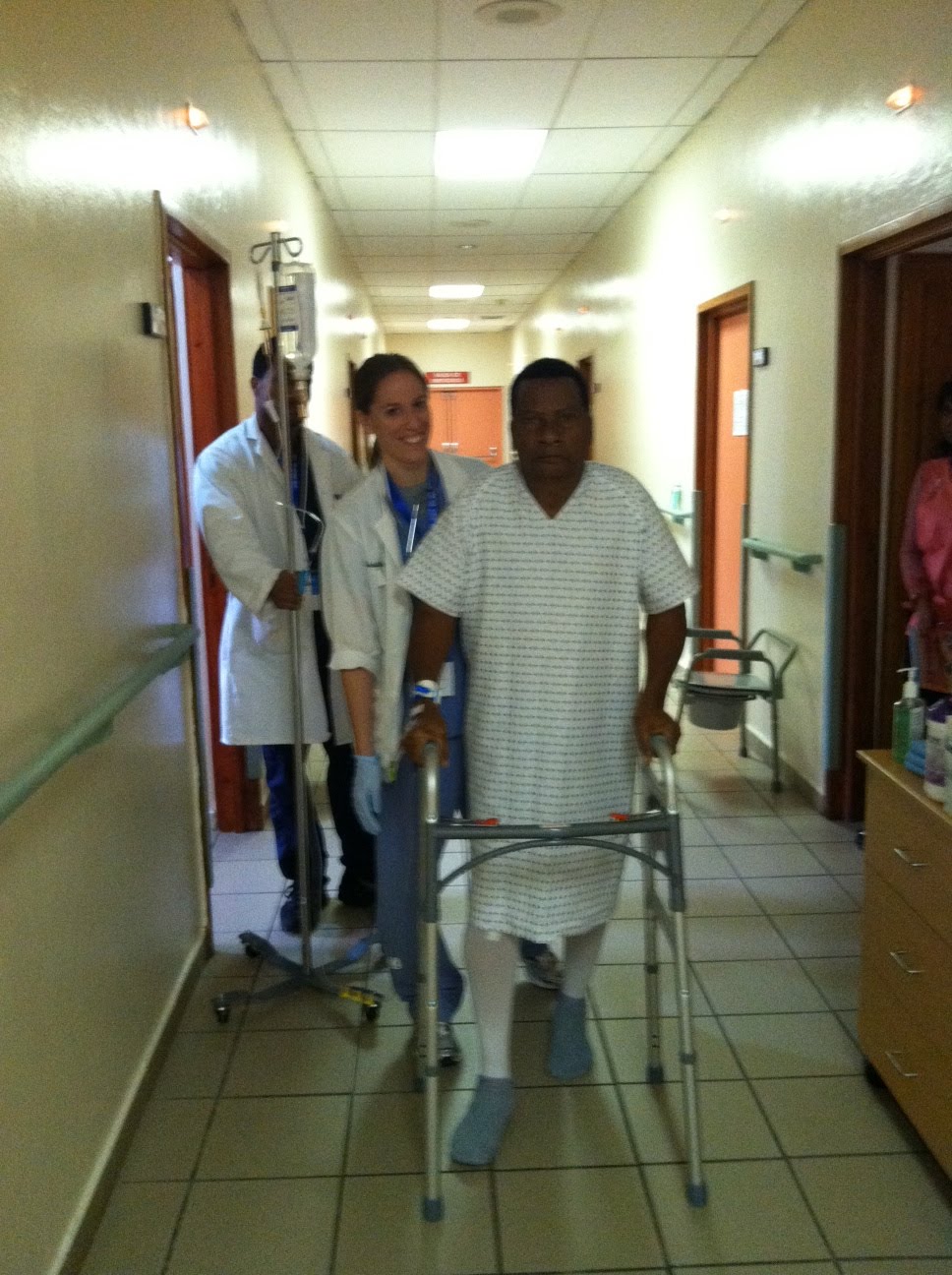
"Si podemos!" Yes we can! has become the unofficial motto of this year's Operation Walk trip. The phrase was coined by one of our post-op patients walking the halls and encouraging her fellow patients. She and the other postoperative patients made great strides today. Passer-byers of the floor could hear intermittent clapping and cheers encouraging patients' on as they achieved new milestones. It was a day of firsts for many patients. For some it was the first trip up a flight of stairs just two days after a knee replacement. For for a few patients it was the first steps after over a year being confined to a wheelchair, including a 46 year old female who has been severely afflicted with rheumatoid arthritis, a systemic inflammatory disease that has involved numerous joints throughout her body. Severe debilitating left hip pain has kept her in a wheelchair for the past 18 months. The recovery of some of our patients has been truly remarkable. One woman could be seen navigating the stairs with her team of medical students and physical therapist just two days after bilateral total knees.
Many factors contribute to a patients recovery following surgery. We have done our best to optimize conditions for our patients. Great focus has been placed on appropriate pain control. Total joint replacements are performed under spinal anesthesia when possible to limit cardiopulmonary risk and postoperative recovery by using minimal sedation while providing adequate intra-op pain control. We optimize postoperative pain control with a multimodal injection of a mixture of diluted ropivicaine and epinephrine into the periosteum (a membrane that lines the outer surface of the bones and contains significant sensory innervation) and the soft tissues, including the posterior capsule. Similar injections have been shown to trend toward better pain control in the immediate postoperative period. More information on this, and other peri-surgical pain control techniques, are discussed by our very own Dr. David Dalury's in his paper entitled "Current and Innovative Pain Management Techniques in Total Knee Arthroplasty" published in the Journal of Bone and Joint Surgery in October of 2011. Additionally, femoral nerve catheters are placed and managed by our anesthesia staff to allow for improved pain control during the first 24 hours post surgery and our nurses work diligently to ensure that pain continues to be addressed adequately on the floor to facilitate recovery.
The goal of joint replacement surgery is to improve function and alleviate pain, making the postoperative physical therapy a key factor in a patients recovery and ultimate outcome. Our dedicated group of physical therapists includes Carolyn Beagan, Brooke Fontana, Emily Ellsworth Cohen, Scott Taylor, and Jillian Ng. Thanks to there tireless efforts, every patient begins therapy the first day following surgery to speed them on their road to recovery.
The intangible factors that contribute to a patient's recovery are often just as important as the medical components. The significance of factors such as motivation, resilience, and determination have never been so apparent to me as while watching the Op Walk patients approach their recovery. Many cannot wait to be out of bed and begin moving. They are so appreciative of the opportunity that lies in front of them, and that appreciation serves as a strong motivator not only for the patients but the medical personnel helping them on there journey. Si Podemos!

Friday, March 23, 2012

Day 2: March 23, 2012

As the Op Walk team returns from a long day, I think it's fair to say that Day 2 has been a rousing success! It was an ambitious day, with 7 patients undergoing bilateral total knees and one patient undergoing a total hip and contralateral total knee. But thanks to the hard work of the operating room staff, the floor and PACU nurses, and the exceptional work of the medical students 16 joint replacements were completed by early afternoon. It is no small feat to complete so many procedures so efficiently and seamlessly even back home in Boston, and is a credit to the spirit of teamwork that epitomizes Operation Walk .


On the floor, the first steps to recovery were underway. Encouraged by inspirational posters handmade by local medical students and the helping hands of our tireless physical therapist, post-op day 1 patients took their first steps on their new joints! Most of the patients see this as an opportunity at a new life which they are eager to begin. Patients awaiting surgery looked on and encouraged their fellow patients. As the schedule for tomorrow was posted, patients and their families literally cheered and danced to find that they would have the opportunity to begin the same journey tomorrow.


Thursday, March 22, 2012

Day 1: March 22, 2012

Op Walk volunteers were welcomed with applause upon arrival to Hospital General De La Plaza de La Salud) by patients who had traveled from near and far. The patients' gratitude was both uplifting and humbling, and the palpable sentiment of hope in the air was inspiring.

The morning began with the preoperative clinic, where each patient was interviewed and examined. Over 40 local medical students have generously volunteered there time to assist with the mission, many of whom served as interpreters for the multidisciplinary team visit with the patients.

After each patient had been seen and examined, Grand Rounds was held, where each patient was presented and discussed at length with input from physical therapy, nursing, anesthesia and the surgical team. This year we are privileged to welcome a fantastic group of outstanding surgeons. Returning veterans include Dr. Thomas S. Thornhill (BWH Chairman of Orthopaedic Surgery), Dr. David Mattingly (Chief of Joint Reconstruction, New England Baptist Hospital), Dr. David Dalury (Chief of Orthopedic Surgery and Adult Reconstructive Surgery at St. Joseph Medical Center in Towson, MD), Dr. Dennis Burke (Hip and Knee Replacement Orthopaedic Surgeon Mass General Hospital, Clinical Instructor in Orthopaedic Surgery Harvard Medical School), as well as welcoming newcomers Dr. Wolfgang Fitz (Brigham and Women's Hospital Orthopaedic Surgeon, Clinical instructor in Orthopaedic Surgery Harvard medical school) and Dr. Ran Schwarzkopf (Brigham and Women's Hospital Arthroplasty Fellow). Each case, ranging from straight forward to complex, was discussed by this panel of experts and the best course of treatment determined. Medical and recovery concerns were addressed and a comprehensive care plan was formulated to ensure the best care possible for each and every patient.

By the afternoon it was off to the OR for the first round of cases. Six patients, undergoing eight total joints among them, were the first of the 2012 Op Walk cases. Meanwhile, the remaining patients were admitted to the hospital for preparation for surgery for over the next week.

With the 2012 procedures underway in the OR, the Op Walk experience came full circle in the follow-up clinic led by Dr. Jeffrey Katz. Over 80 returning patients from previous Op Walk trips returned for follow-up. The sentiment of gratitude and hope that was so pervasive in the morning clinic carried over to the afternoon, rallied by the happy returning faces. Physicians and physical therapist evaluating patients were privileged to stories of recovery and progress from beaming and grateful patients. The information gathered today will be integrated into Dr. Katz's research regarding the outcomes from the missions over the past 5 years.

It was a successful first day thanks to the efforts of Dr. Luis Alcantaro and his dedicated medical students, as well as the Op Walk Mission members.


Wednesday, March 21, 2012

Day 0: March 21, 2012

Energy and anticipation were high as the 2012 Op Walk Mission has now officially begun! Today was a travel day for the majority of the group, as volunteers made their way from Boston to Santo Domingo. We arrived to sunny weather with some brief showers on the drive in culminating in a rainbow over the ocean to welcome the travelers to the Dominican Republic!

We joined the rest of the team who had arrived a few days prior and have already been hard at work preparing for the week ahead. Over 400 boxes of supplies were delivered to the Hospital General De La Plaza De La Salud, including palates full of donations from our generous sponsors which will allow us to provide total joint replacements to 37 Dominican Republic residents over the coming 7 days. Op Walk members Paul Laemmle and Debbie Pitts spent the day organizing this mass of boxes into a central supply room that will serve the 4 ORs during the course of the mission. Elsewhere, others including chief medical officer Dr. Collin May, Chief Operating Officer Roya Ghazinouri, and nursing coordinator Barbara Aggouras were hard at work preparing the preop, postop and clinic for the mission.

With the final steps after months of preparation complete, the Op Walk team met for a welcome dinner to kick off the start of the week. Dr. Thomas S. Thornhill welcomed new and returning team members, and Dr. May outlined the schedule for the upcoming week. There was an air of excitement amongst the over 50 Op Walk team members as we look forward to a what is sure to be an amazing week!


Monday, March 19, 2012

Op Walk in the Globe!

Congratulations to one of Op Walks finest who was featured in the Boston Globe, Dr. Mercedes Concepcion! Read more about Dr. Concepcion and the Op Walk Mission in the March 9th article.

http://articles.boston.com/2012-03-09/health-wellness/31145350_1_patients-joint-effort-hip-and-knee-replacements

http://www.bostonglobe.com/lifestyle/health-wellness/2012/03/11/mission-healing-joint-effort/NrFMJRV7RClDaRN6EukROI/story.html